
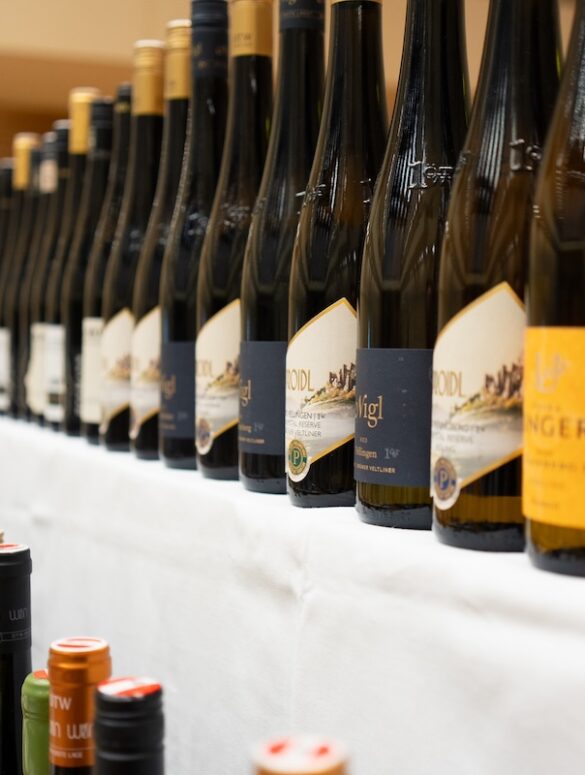

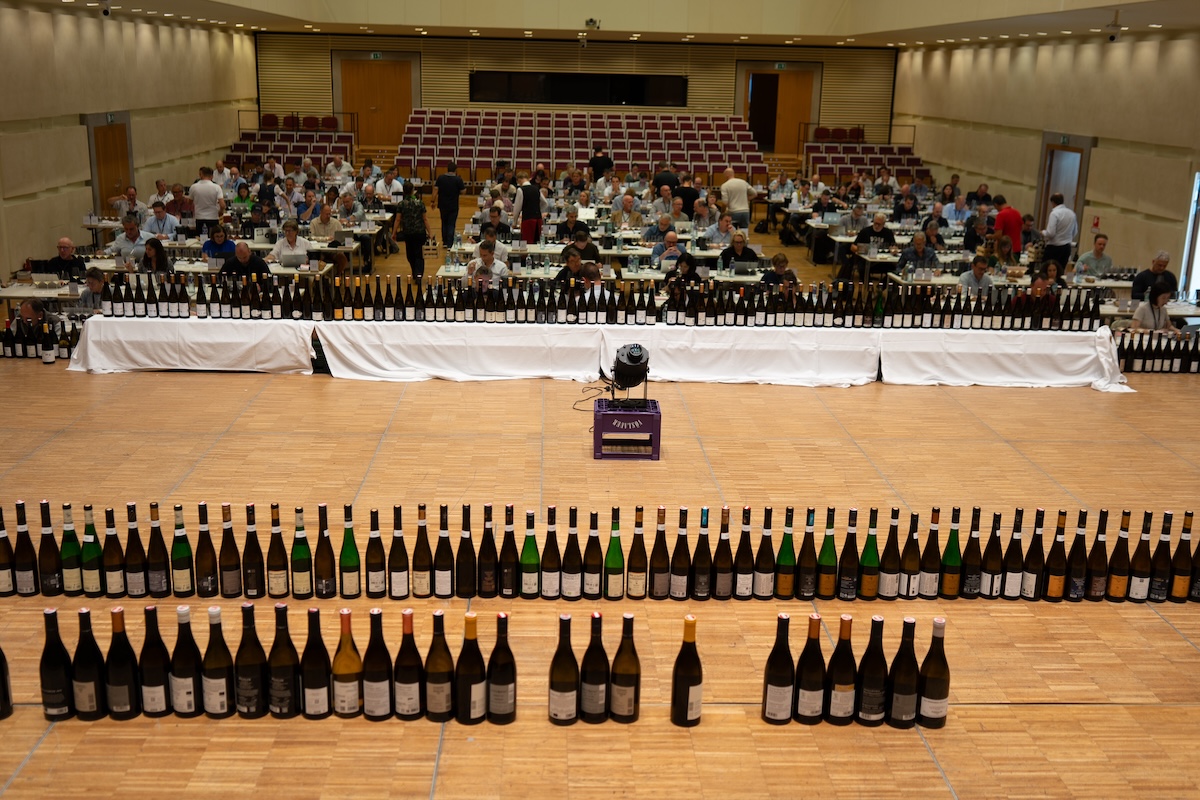
If sipping through hundreds of Austrian wines within days is something you enjoy, a yearly held masochistic chaos of the Österreichische Traditionsweingüter Single Vineyard Summit is what you need. Armed with a spittoon, a moderately clean palate, and a sheer audacity to judge the life’s work of generations of dirt-worshipping vine-whisperers you’re headed to a vast, sort-of-silent room and left with the clinking of glassware, the aggressive swishing of liquid against teeth, and the collective existential crisis of wine folks desperately trying to find a socially acceptable synonym for minerality. I survived it, bare-teethed and purple-lipped, scribbling tasting notes (well, so to speak, who the hell scribbles these days?).
It’s about time to dissect the data, unearth the trends, and figure out exactly what paying for the 1ÖTW label on the wine label gets you. Because, unfortunately, most of us won’t get these wines poured for free.
Trying to understand the complexities of the Austrian Erste Lagen classification is a challenging experience. Unpair everything you thought you knew about wine classifications, turn off your preconceived notions, press the mental reset button for three seconds until your brain fast-flashes, and only then, when the “pairing dialogue” finally pops up, let the terroir and the grapes finally work together in your mind.
To fully grasp this, we must look at the architects of this system. If you have read my interview with Michael Moosbrugger, you know the gravity of what the 1ÖTW represents. Moosbrugger, the calmly diplomatic mastermind who recently announced he is passing the baton to the next generation, has spent the better part of two decades steering this ship. The association started as a radical idea in the late eighties and early nineties, a time when a group of renegade winemakers decided to fight against mass-produced, corporate wine. Their goal was to make Austria’s finest vineyards visible, comprehensible, and ultimately enshrined in national law. They pushed for a paradigm shift where the origin, the specific plot of land, becomes more important than the grape variety. Wine Summits are the ultimate manifestation of that crusade, an annual silent tasting where the 1ÖTW Erste Lagen, the Premier Crus of Austria, are laid bare for our judgment, pushing us, year after year, closer to the announcement of Austrian ÖTW.GGs, the Grand Crus.
Swirled and tasted
Let’s carve this vast experience by region—first. Out of the three hundred and seventy wines I tasted, a staggering two hundred and seventy six hailed from Niederösterreich. This is Lower Austria throwing its massive viticultural weight around, proving that the Danube and its surrounding valleys are the undisputed heavyweight champions of the Austrian wine scene. Kamptal, Kremstal, Wachau, Wagram, they all showed up flexing their loess, primary rock, and Gföhler gneiss soils. Another story is the plucky, brilliant resistance from the borders. Steiermark marched in with forty one rated bottles, bringing that razor-sharp Alpine freshness. The region of Wien, proving once again why it is the only capital city on Earth with a world-class wine industry within its city limits, offered twenty nine glasses of urban grit and historical charm. Meanwhile, Burgenland slipped in twenty four wines, mostly to remind they don’t just make big reds.
Analyzing the vintages is essentially an exercise in predicting the future. You are often tasting raw nerves and unresolved tension. The 2024 vintage completely dominated my glass with 173 entries, averaging an entirely respectable 89.1 points. However, the real sweet spot, the vintage that repeatedly made me pause and stare contemplatively at the ceiling, was 2023. With 147 wines rated, it pulled an average of almost 89.8. The 2023s had a full year to settle their differences, to integrate their soaring acidity and start having a “conversation”. There were older “ghosts” in the room too, a smattering of 2022s averaging over 89.3, a few deeply complex 2021s, and even a solitary 2016 that clocked in with a bit underwhelming 90 points.
What happens when we dive into the grapes themselves? Grüner Veltliner, the undisputed, slightly peppery king of Austrian white wine, fielded an overwhelming 165 contenders averaging 89.35 points, but more importantly, they possessed the highest ceiling, peaking at a mind-bending 95 points. Riesling, the nervous, highly-strung, aristocratic cousin, offered 87 wines with a slightly higher baseline average of 89.56, peaking at 93.
What should you expect from a typical 2024 Grüner Veltliner across the ÖTW producers if you pop one of these open right now? My tasting notes read like the diary of a manic botanist: we are talking dusty, mineral aromas and bright, exotic tastes. There were rampant notes of peach and green herbs, flint, gunpowder, and even intense plums. It’s a beautiful contradiction of a grape, somehow lush, wide, and forgiving, yet simultaneously crisp, clean, and anchored by a profound, stony minerality. The top examples were deep, complex and juicy, but en masse I wouldn’t recall the next day. Was it their extreme youth that broke me? I bet it was.
My Top Grüner Veltliners
- Salomon Undhof, Grüner Veltliner, Ried Lindberg, 2023 – Wide, autumnal, superbly balanced complex acidity. (95)
- Lahrnsteig, Grüner Veltliner, Ried Poigen, 2024 – Dusty mineral aroma, bright, juicy, exotic structure. (94)
- Hutter Silberbichlerhof, Grüner Veltliner, Ried Alte Point, 2023 – Rich, peachy, deeply balanced with floral depth. (94)
- Josef Schmid, Grüner Veltliner, Ried Gebling, 2023 – Juicy yellow fruit with flamboyant, lively acidity. (93)
- Rudolf und Verena Kiss, Grüner Veltliner, Ried Backobel, 2017 – Complex, autumnal, showing oxidized petrol touch. (93)
- Türk, Grüner Veltliner, Ried Thurnerberg, 2024 – Crisp, clean peach with amazing oaky style. (93)
- Sommer, Grüner Veltliner, Ried Himmelreich, 2023 – Rich, expressive acidity with complex floral drive. (93)
- Bründlmayer, Grüner Veltliner, Ried Lamm, 2023 – Complex exotic fruit with nice oaky depth. (93)
- Steininger, Grüner Veltliner, Ried Lamm, 2024 – Gently balanced peach and tender floral softness. (93)
- Taubenschuss, Grüner Veltliner, Ried Tenn, 2022 – Mouthwatering richness driven by wonderfully juicy acidity. (93)
Numbers, however, are just soulless integers until you attach names and sweat to them. We need to talk about the specific champions, the bottles that made me forget I was technically working. The absolute pinnacle of my tasting, sitting alone at the top of the mountain with 95 points, was the Salomon Undhof Lindberg 2023. This Grüner Veltliner simply refused to be ignored. My notes from that exact moment are a testament to its glory: wide body, autumnal, superb acidity balanced perfectly with fruit, great complexity without any aggressive spikes, and a delicate, lingering hint of apricot. It was an absolute masterclass in harmony.
Then there was the Proidl Pfeningberg 2024 Riesling, scoring a massive 93 points. Now, I love a pungent petrol note on an aged Riesling as much as the next degenerate wine writer, but this wine was entirely different. It was all deep herbal nose, white peach, and apricot, completely devoid of petrol, delivering just pure, unadulterated, youthful complexity. We also cannot overlook the Strawanzer Donabaum 1000-Eimerberg 2023 Riesling, another 93-pointer that did bring a tiny bit of that beloved petrol, perfectly married to white peach and a wide, autumnal maceration style. And for pure Grüner power, the Hutter Silberbichlerhof Alte Point 2023 delivered a rich, mild, floral, and peachy experience with astonishing depth, earning an easy 94 points, matched only by the Lahrnsteig Poigen 2024 Grüner, which hit 94 points on the back of its juicy, exotic, and dusty mineral profile.
My Top Rieslings
- Jurtschitsch, Riesling, Ried Loiserberg, 2023 – Magical depth, complex exotic pineapple, beautifully bright. (93)
- Winzerhof Fam. Dockner, Riesling, Ried Gottschelle, 2023 – Exotic, rich, juicy aroma with off-dry finish. (93)
- Proidl, Riesling, Ried Pfeningberg, 2024 – Deep herbal nose, white peach, no petrol. (93)
- Strawanzer Donabaum, Riesling, Ried 1000-Eimerberg, 2023 – Balanced white peach, subtle petrol, autumnal maceration. (93)
- Hofstätter, Riesling, Ried Singerriedel, 2024 – Great juicy acidity, bright, flowery, and peachy. (93)
- In Vino Weix Weixelbaum, Riesling, Ried Gaisberg, 2022 – Layered grapefruit, white peach, serious balanced complexity. (93)
- Franz Hirtzberger, Riesling, Ried Hochrain, 2024 – Deep, autumnal petrol notes with pungent acidity. (92)
- Franz Hirtzberger, Riesling, Ried Singerriedel, 2024 – Intensely juicy, delivering beautifully vibrant exotic fruit. (92)
- Piewald, Riesling, Ried Offenberg, 2023 – Wide, lush, wonderfully sweet and juicy exotics. (92)
- Piewald, Riesling, Ried Biern, 2024 – Pungent, beautifully warming citrus with great balance. (92)
Let us pivot to the great dichotomy: whites versus reds. Austria is a white wine country, right? The global market says yes, the exports say yes, and my data says yes, with 357 whites rated compared to a mere 12 reds. But here is where the statistics start to ruthlessly mess with your preconceived notions. The white wines averaged 89.36. The reds? 90.91, not a typo.
When we drill down into the specific Pinot Noir versus Chardonnay battle, the narrative gets even wilder. You would expect Chardonnay to rule the roost of international varieties. 20 Chardonnays were tasted, pulling an average of 89.95, with absolute standouts like the Braunstein Thenau 2021 at 93 points, which tasted wonderfully like warm apple cake, joyous and playful, and their Guttenberg 2023, also 93 points, which was rich, juicy, and heavily leaning on the exotic side. But the Pinot Noir? Only six were rated, but they averaged an astonishing 92.67 points.
All Pinot Noirs
- Reinisch, Pinot Noir, Ried Kästenbaum, 2022 – Beautiful petal rose and light oak bomb. (94)
- Heinrich Hartl, Pinot Noir, Ried Graf Weingartl, 2023 – Elegant forest floor harmony with oak profile. (94)
- Bio Georg Schneider, Pinot Noir, Ried Tagelsteiner, 2023 – Complex sweetish forest and distinct geranium notes. (93)
- Reinisch, Pinot Noir, Ried Holzspur, 2022 – Beautifully balanced, nuanced, and intensely multifaceted complexity. (92)
- Bio-Familie Auer, Pinot Noir, Ried Holzspur, 2022 – Soft red fruit integrated with vanilla oak. (92)
- Leo Aumann, Pinot Noir, Ried Bockfuss, 2023 – Strict, focused profile showing roses, light fruit. (91)
This is where I must issue a very specific caveat to the professional critics and statistical purists waiting to tear me apart. Yes, six wines is a microscopically small sample size. I am not declaring Austrian Pinot Noir the absolute, undisputed conqueror of Burgundy based on half a dozen glasses in a silent room. I am remaining safely and vaguely exuberant by suggesting that when the top ÖTW producers decide to dedicate their time and terroir to Pinot Noir, they absolutely do not miss. Take the Heinrich Hartl Graf Weingartl 2023 Pinot Noir, which scored 94 points. A flawless symphony of forest floor, an elegant, well-done oaky profile, and incredible structural harmony. Or the Reinisch Kästenbaum 2022 Pinot Noir, another towering 94-pointer, a beautiful tutti-frutti bomb elevated by light oak and a delicate petal rose aroma. These are not afterthoughts; these are serious, contemplative wines that demand your complete attention.
Finally, we must honor the champion vineyards, the specific Rieds that consistently delivered the goods across multiple producers and varieties. If the ÖTW’s primary mission is to elevate the vineyard above the grape, then this data absolutely supports their crusade. When you average out the scores, certain patches of terroir simply produce undeniably better wine. The Ried Poigen led the entire pack with a staggering average of 92.5 points. It was followed closely by the legendary Lindberg and Holzspur, both averaging a massive 92 points. Tatschler, Singerriedel, and Karlsberg all clustered tightly together at a formidable 91.66 average. And let us certainly not forget the mighty Ried Lamm, which fielded 8 different wines in the tasting and still maintained a crushing, undeniably consistent average of 91.25. These are not just hard-to-pronounce names on a topographic map.
Producers going Super Novae
When analyzing the producers with the highest number of top-rated wines from the 2025 ÖTW Single Vineyard Summit, it is crucial to establish that this data represents a personal lottery. Given the sheer volume of submissions, I did not taste every single wine presented at the show. The resulting metrics are inherently tied to my specific tasting path through the event, meaning some exceptional producers might not be represented here simply because their bottles did not end up in my glass. However, within the subset of wines I did evaluate, a few producers clearly distinguished themselves by consistently achieving scores of 92 points or higher across multiple entries.
My Top Blends and Other Grapes
- Liechtenstein, Cuvée, Ried Karlsberg, 2023 – Lush exotic fruit balancing citrus and salinity. (93)
- Fred Loimer, Cuvée, Ried Loiserberg, 2023 – Complex, thin, elegant exotic pineapple showing brilliantly. (93)
- Dürnberg, Weißer Burgunder, Ried Kirchberg, 2022 – Deep gunpowder flint accented by light vanilla. (92)
- Reinisch, St. Laurent, Ried Holzspur, 2022 – Soft, juicy, lush profile with integrated wood. (92)
- Tement, Sauvignon Blanc, Ried Grassnitzberg Riff, 2022 – Bright, clean, wonderfully direct pineapple driven wine. (92)
- Bayer – Erbhof, Weißer Burgunder, Ried Kapellenjoch, 2023 – Subtle, tender natural aromatics with great harmony. (92)
- Wagentristl, Pinot Blanc, Ried Tatschler, 2023 – Light green apple showing easy lees nose. (92)
- Josef Fritz, Roter Veltliner, Ried Steinberg, 2024 – Elegantly balanced milky oak with precise acidity. (92)
- Gebeshuber, Zierfandler, Ried Modler, 2023 – Beautifully balanced, nuanced wine showing bright pineapple. (91)
- Prieler, Pinot Blanc, Ried Haidsatz, 2023 – Complex, light sour apple with reductive nose. (91)
Weingut Reinisch emerged as the most successful producer within my tasting sample, securing three spots in the top-rated tier. Their performance was driven by red varieties, which is a notable achievement in a predominantly white wine landscape. Their highest-scoring wine was the 2022 Pinot Noir from Ried Kästenbaum, which achieved 94 points. They followed this with two 92-point entries from the Holzspur vineyard: another 2022 Pinot Noir and a 2022 St. Laurent. This consistency across different red grapes and vineyards demonstrates a significant mastery of their specific terroir.
Jurtschitsch also demonstrated remarkable consistency, matching Reinisch with three wines scoring 92 points or above, but focusing entirely on white varieties. Their top wine was the 93-point 2023 Riesling from Ried Loiserberg, supported by two 92-point Grüner Veltliners from the Lamm and Dechant vineyards, both from the 2023 vintage. Additionally, Weingut Braunstein deserves a specific mention for achieving two 93-point scores, which is the highest average among producers with multiple top wines. Both of their top entries were Chardonnays: the 2023 Ried Guttenberg and the 2021 Ried Thenau.
If we are talking about absolute Riesling royalty, we must talk about the estates that treat this highly-strung grape like a demanding but ultimately rewarding muse. Franz Hirtzberger, a legendary name in the Wachau, proved exactly why their reputation precedes them by landing two 2024 Rieslings—from the hallowed Ried Hochrain and Ried Singerriedel—at a rock-solid 92 points. Both wines were intensely juicy, deep, and beautifully exotic, showcasing that classic autumnal Wachau tension. Matching this sheer high-wire Riesling energy was Weingut Proidl from the Kremstal. They delivered a spectacular 93-point knockout with their 2024 Ried Pfeningberg, a wine that completely ignored the standard petrol playbook in favor of a deep herbal and white peach complexity, followed closely by an excellent 92-point showing from their Ried Ehrenfels.
My Top Chardonnays
- Kirchknopf, Chardonnay, Ried Tatschler, 2023 – Wonderfully oaky with distinct chalky mineral profile. (93)
- Markus Altenburger, Chardonnay, Ried Jungenberg, 2022 – Juicy, deep, intensely balanced dominant exotic apricot. (93)
- Braunstein, Chardonnay, Ried Guttenberg, 2023 – Rich, juicy exotics with pleasantly pungent aftertaste. (93)
- Braunstein, Chardonnay, Ried Thenau, 2021 – Playful juice recalling warm, joyous apple cake. (93)
- Anita & Hans Nittnaus, Chardonnay, Ried Freudshofer, 2023 – Wide, juicy balance highlighting beautiful white peach. (93)
- Mayer am Pfarrplatz und Rotes Haus, Chardonnay, Ried Langteufel, 2024 – Elegant, lush balance of oak and acidity. (92)
- Sommer, Chardonnay, Ried Riefring Thal, 2023 – Extremely bright, sour peach with nice reduction. (91)
- Mayer am Pfarrplatz und Rotes Haus, Chardonnay, Ried Preussen, 2024 – Warming, highly citrusy profile with pleasant acidity. (90)
- Bayer – Erbhof, Chardonnay, Ried Martinsberg, 2023 – Beautifully balanced oaky style with distinct lees. (90)
- Esterhazy, Chardonnay, Ried Lamer, 2023 – Elegant fine lees, subtle exotics, gracefully toned. (90)
Then there are the producers who flat-out refuse to be pigeonholed, thriving on sheer viticultural versatility. Fred Loimer absolutely crushed it by proving you do not need to stick to single-varietal dogma to win the day. His 2023 Cuvée from Ried Loiserberg hit a brilliant 93 points, offering a thin, elegant, and complex pineapple profile that tasted like pure magic, which he casually backed up with a 92-point Grüner Veltliner from Ried Käferberg. Bayer-Erbhof played a similar game of dual-threat dominance. They managed to land two 92-point wines across completely different spectrums: a wonderfully bright 2023 Grüner Veltliner from Ried Himmelreich and a deeply subtle, naturally aromatic Weißer Burgunder from Ried Kapellenjoch that simply hummed with harmony.
Finally, we have to respect the absolute stalwarts of Austria’s signature grape, the producers who strapped Grüner Veltliner to their backs and carried it up the mountain. Weingut Türk delivered an absolute masterclass in Veltliner expression, securing 93 points for their 2024 Ried Thurnerberg—a wine that teased an amazing oaky style (or perhaps just brilliant lees work) while remaining crisp and clean—and adding a 92-point Ried Frechau to their trophy cabinet. Standing shoulder-to-shoulder with them is Ebner-Ebenauer, who brought a devastatingly consistent one-two punch of 92-point 2024 Grüners from Ried Hermannschachern and Ried Sauberg. These estates are the beating heart of the classification, proving that when Grüner Veltliner meets the right patch of land and a winemaker who refuses to compromise, the results are nothing short of electric.
To finish with something…
In the end, what did the massive spreadsheet of wine notes actually teach me? That Austrian wine is currently existing in a state of exuberant, thrilling evolution. The wildly youthful 2024s are bursting with raw, exotic potential, while the slightly older 2023s are settling into a profound, autumnal elegance that rivals anything in Europe. The white wines remain the reliable, crystalline, razor-sharp backbone of the industry, but the reds, particularly those shockingly good Pinot Noirs, are lurking in the shadows, ready to completely steal the show when you least expect it. The vineyards themselves, the hallowed Rieds, are speaking louder than ever before, validating Moosbrugger’s decades-long campaign for terroir recognition.