

I’ve known Burgenland as home of the brave, young and hip winemakers for years, the “Pannobile Cluster” was always on top of my wine pyramid, wineries that distinguish this region from others finest. What I didn’t know was I was mistaken and Pannobile was not the end of the line. It’s the beginning. And Hannes Schuster’s wines served as the ultimate revelation.
While I spent only 45 minutes at Rosi Schuster table (the winery is named after Hannes’ mother Rosi who is still engaged in the winery, they say), internally I became years older, or, let’s keep it kinder to me, years wiser. So get ready—this very same wisdom is coming at you. Like, right now!
To get to the core of what Hannes is doing, I needed to look back to the late 1970s. That’s when his parents, Rosi and Franz, laid the foundation for the beauty we witness today. Rosi brought the practical viticulture schooling from Eisenstadt and the family roots in Sankt Margarethen, while Franz—a professor for cellar management—brought his own three hectares of vineyards. Because Franz kept teaching full-time, Rosi took the reins as head winemaker: the cool women! Naturally, the estate took her name.
When Hannes started making wine there in 2000 while still in school, the estate looked a bit different, heavily focused on international and French varieties. The young pal began experimenting under the radar with indigenous Sankt Laurent, finding his own voice without the weight of parental or customer expectations. By 2005, when his father fell ill, Hannes fully stepped into the 12-hectare family business. Following Franz’s passing in 2007, Rosi officially handed over the keys.
What followed was a radical stripped-back reformation: Hannes and Rosi shifted the estate to organic farming (certified since 2014) and intentionally shrank the vineyard area by clearing, selling, or swapping out the international varieties. He redirected the entire focus onto indigenous heroes: Blaufränkisch and Sankt Laurent, alongside whites like Grüner Veltliner and Furmint.
Today, they handle 14 hectares split across 40 minuscule parcels spanning six different villages. Rather than hyper-focusing on single-vineyard bottlings, Hannes channels these plots into village Crus that reflect the absolute purest expression of the Pannonian basin. No added sugars, no artificial acidity corrections, just hand-harvested grapes, spontaneous fermentation, minimal oak influence, and long, patient aging on the lees.
Tasting through these wines is an eye-opening and mouth-watering experience, among the other descriptors which I will only mention in a private setting. There’s one word for these wines—immense elegance. Sorry, it’s two. Hannes doesn’t hold back from serving both his whites and reds chilled; kill me, I’m lovin’ it.
He poured me Aus Den Dörfern 2025 that immediately screamed depth and elegance. It’s very clear that the effort that goes into Hannes’ entry-level white cuvée would constitute a full-fledged top cuvée for other winemakers. The single-vineyard selection consists of Grüner Veltliner and Gemischter Satz (Welschriesling, Furmint, Pinot Blanc, and Chardonnay). The wine’s taste affirms its dominance in the glass: flinty, round, smoky, complex, mineral. I could go on but the next one, Furmint 2025, breaks my concentration, another very particular and beautiful liquid that immediately puts Schusters on Austria’s Furmint Map—if it actually exists. It’s done: Burgenland’s Furmint has made a comeback in my mind and Tokaj is fading away (well, not really, calm the F/down, fellaz). Another liquid washes the glass, a barrel sample of higher-tier Sankt Margarethen Furmint 2023, and this one hits the tastebuds really hard with its depth and sudden attack, yet another showcase of the Pannonian terroirs and their mystical complexity that makes these wines possible along with the winemakers’ efforts.
At this point I could only imagine what the Schuster’s reds would show. And they showed a freaking lot: silky smooth texture, bright aromas, absolutely no hints of funkiness that sometimes defines low-intervention producers. Hannes isn’t one of them. None of his wines have rough edges or sharp angles, how the hell does this work?
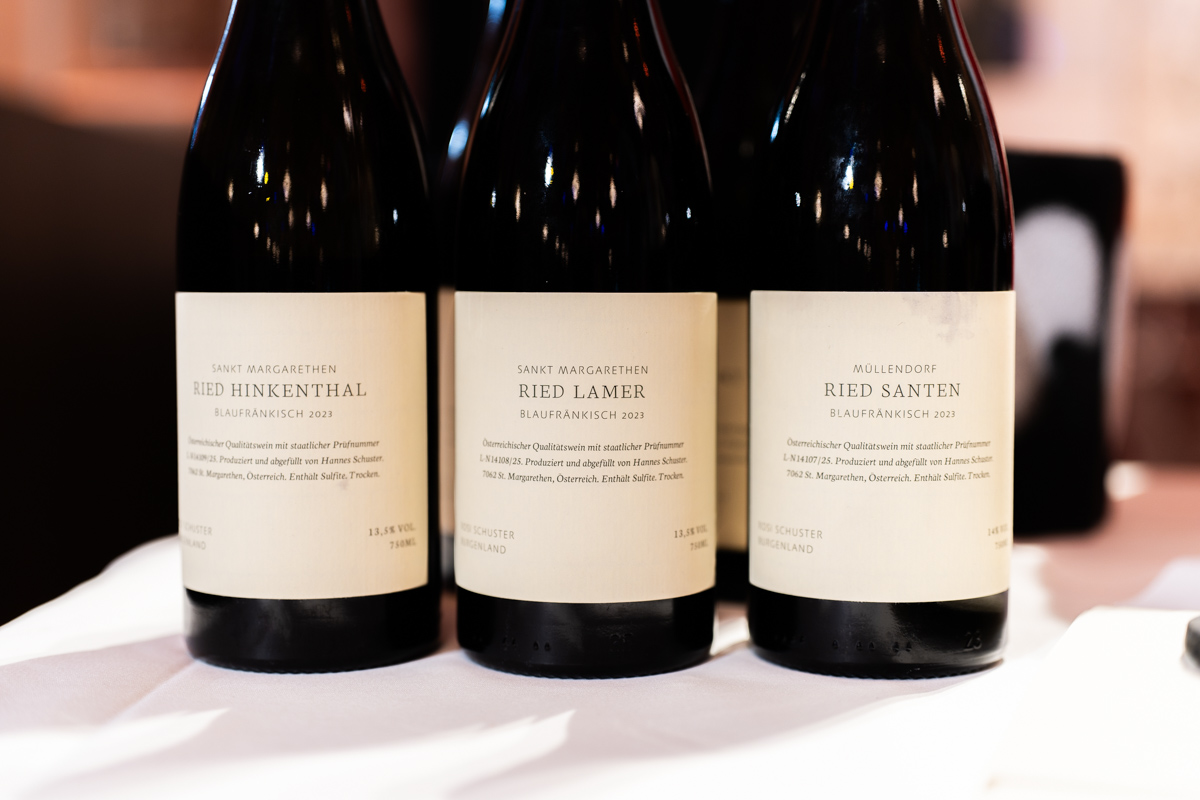
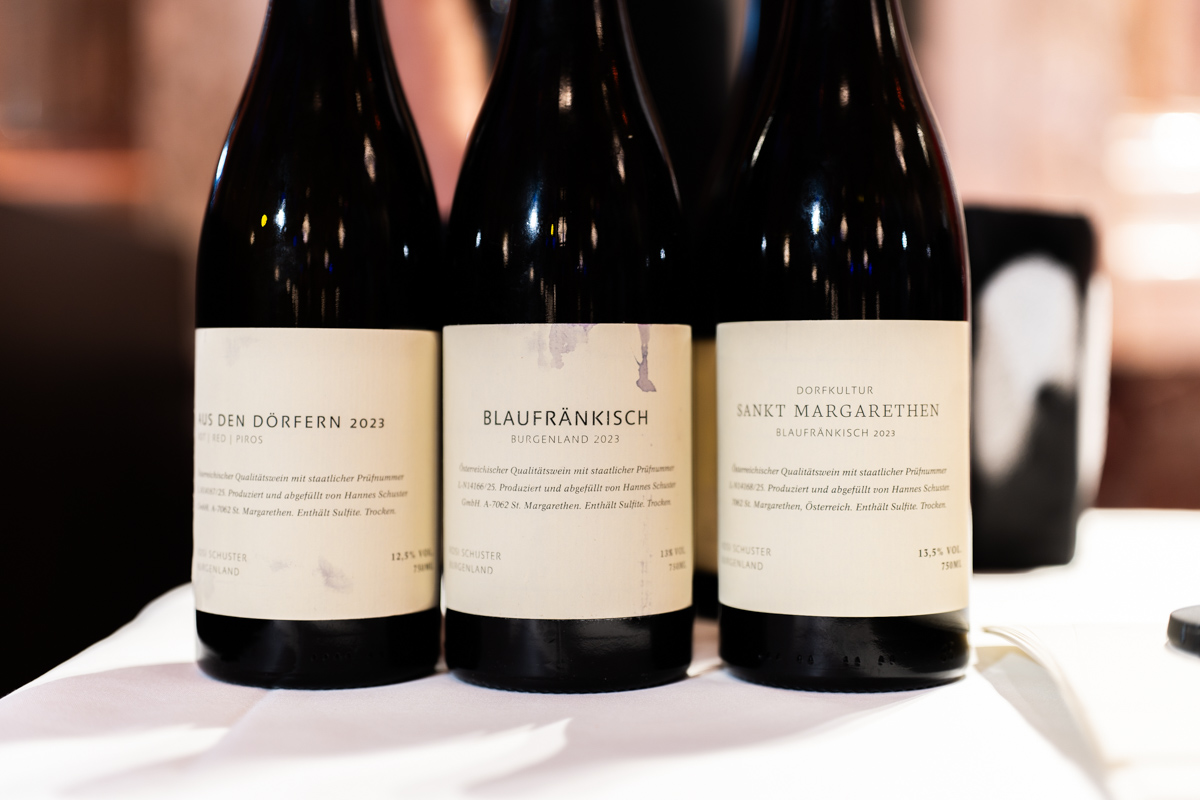
Among the mid-tier Village reds is Aus Den Dörfern 2023, a beautiful easy drinking blend with complexity to substantiate a single bottle per person for lunch in my eyes. A Blaufränkisch 2023 came out to be an example of striking beauty (92) and Blaufränkisch 2023 Sankt Margarethen showcased some stunning depth and, as mentioned how many times now?—monumental elegance (93). The single-vineyards are all Uber-Kool (this sounds German enough) and all hit the higher spheres of my mind, Ried Hinkenthal Blaufränkisch 2023 with its amazing depth and silkiness (95), Ried Lamer Blaufränkisch 2023
a bit cooler, but with extremely vivid character and calcareous minerality (95) and Ried Santen Blaufränkisch 2023 with its immense length, smokiness and ample juicy texture (96).
It’s clear the Schuster method works, whatever it is. And now you kind of know what I went through that day. While Burgenland remains a dream place to visit with all the cool kids on the Pannonian block, I am happy that wines like these are actually presented at VieVinum and not just at some oligarchs’ closed-doors wicked feasts.
I’d drink to that.