
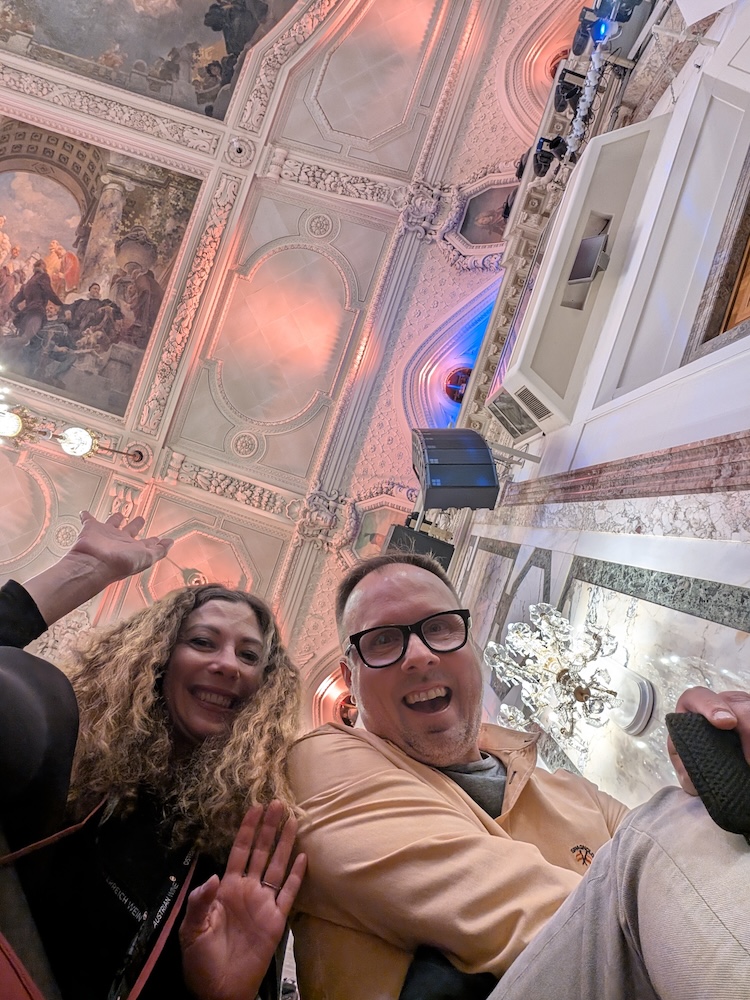

It’s mid-May 2026, and the Austrian wine industry has once again hijacked the Hofburg Palace in Vienna. Swirling wine under the crystal chandeliers of the Habsburg dynasty feels incredibly chic—for about fifteen minutes. The reality is that the Hofburg is a sprawling, decentralized labyrinth of marble staircases, narrow corridors, and disconnected halls. Trying to execute a systematic tasting of 550 exhibitors across this imperial real estate requires the logistical precision of a military campaign.
The exhibition runs on a strict dual concept. From 9:00 a.m. until 1:00 p.m., the floor is reserved strictly for trade and press. You get exactly four hours to navigate the maze, taste, spit, and take coherent notes before palate fatigue sets in. Covering the entirety of Austrian viticulture in 240 minutes is a mathematical impossibility.
At exactly 1:00 p.m., the floodgates open to the general public—some 16,000 visitors over the course of the event. The atmosphere instantly shifts. The noise level doubles, the room temperature spikes, and you find yourself fighting for space at a spittoon with tourists who just want “a nice sweet red.” If you didn’t get your serious evaluation done in the morning, your window is officially closed.
The White Wine Behemoths: Acid and Impatience
In the grandest halls, you hit the heavy armor of the industry: the ÖTW Traditionsweingüter and the formidable Vinea Wachau. These associations represent the old-guard discipline and the meticulous classifications that put Austria’s dry whites on the map.
The Vinea Wachau tables operate with intense precision. Their Steinfeder, Federspiel, and Smaragd hierarchy translates the terraced stone walls of the Danube directly into the glass. Countering that is the massive footprint of the ÖTW Traditionsweingüter, diving deep into the diverse soils of Lower Austria with their Erste Lagen (Single Vineyard) wines.
But the trade calendar forces a brutal reality: these producers are pouring the freshly bottled 2025 vintage. Tasting a 2025 Erste Lage Riesling at 10:00 a.m. on a Tuesday is masochism. These wines are structurally brilliant, but they are tightly wound infants. They demand years in the cellar, yet here we are, judging them in a chaotic, three-minute window. It feels fundamentally unfair to the wine, but it’s the nature of the beast.
The Carnuntum and Thermenregion Rescue Mission
Once the Kamptal acidity starts stripping your tooth enamel, you need a pivot. Navigating away from the Danube brings you to the fleshy, grounded reality of Carnuntum and the Thermenregion.
Johannes Trapl is crucial for understanding modern Carnuntum. He ignores the heavy makeup of new oak and extraction, delivering Blaufränkisch and Zweigelt that actually taste like the cool, elegant spice of the dirt they grew in.
A short sprint away, Fischer Winery and Familie Reinisch prove that Austria has a serious mastery of red Burgundy varieties. Reinisch, in particular, crafts Pinot Noir and St. Laurent that blend alpine freshness with a deep, earthy soul, silencing anyone who thinks you need to be in the Côte-d’Or to make terroir-driven Pinot.
Styrian Vertigo and the Saxon Interloper
Escaping to the Zeremoniensaal to tackle Steiermark (Styria) is the only cure for mid-morning palate fatigue. The Sauvignon Blancs here are famous, but tasting through them side-by-side can be a punishing assault of gooseberry if you aren’t selective.
You survive by sticking to the absolute benchmarks. Sattlerhof treats Sauvignon Blanc with an intellectual precision that yields complex, age-worthy wines, bypassing the green, pungent stereotypes entirely. Weingut Schauer grounds the experience with pure, vibrant, mineral-driven expressions that honestly capture the terrifyingly steep slopes of Southern Styria.
And just when your Central European palate is dialed in, the guest exhibitors throw a curveball. Martin Schwarz, pouring from Saxony, Germany, proved that serious, cool-climate winemaking is thriving well beyond Austria’s borders. It’s a necessary, grounding contrast to the surrounding Austrian bravado.
The Pannobile Vanguard: Where the Soul Lives
If there is a beating heart of modern Austrian wine, it’s in Burgenland, anchored by the Pannobile association. This group from Gols figured out decades ago that chasing homogenized international point scores is a dead end. Tasting through their roster is a reminder of why we put up with the exhausting event logistics.
The Rennersisters inject a wild, untamed energy into the region with skin-contact whites and lively reds that act as a jolt to the system. Judith Beck takes a biodynamic approach that yields wines of fluid grace, proving Zweigelt can have incredible depth without heavy extraction. Nearby, Claus Preisinger pushes minimalism to the edge. His raw, electric Pinot Noirs walk a razor-thin line between chaos and perfection.
The association’s weight is carried by Weingut Heinrich, a winery that successfully shifted away from the jammy reds of the 90s to focus on breathtakingly pure, limestone-driven biodynamic farming. Right next to them, Andreas Gsellmann bottles the exact essence of Heideboden terroir, his wines deeply reflective of the clay and gravel soils of his vineyards.
The Burgenland Titans: Iron, Limestone, and Blaufränkisch
As the afternoon crowds begin to rumble through the halls, a desperate dash for the remaining heavy hitters is mandatory.
Birgit Braunstein channels a deep connection to the Leithaberg limestone into reds and whites of jaw-dropping elegance—wines built for the cellar with a quiet, confident longevity.
Then you hit the titans of pure terroir expression. Moric, spearheaded by Roland Velich, treats Blaufränkisch like Grand Cru Burgundy. The result is a feral, spicy, and hauntingly beautiful wine that redefined Austria’s red identity globally. Under the guidance of Hannes Schuster, Weingut Rosi Schuster focuses on old vines to yield Sankt Laurent and Blaufränkisch of stunning purity and brooding intensity.
Finally, before the hordes completely overrun the tables, you track down Uwe Schiefer. Schiefer’s wines from the iron-rich soils of the Eisenberg are uncompromising, structural beasts that strip away any remaining complacency from your palate.
The Bitter End
By 4:00 p.m., your teeth are purple, your tasting notebook is a disaster of wine-stained scribbles, and the air in the Hofburg has grown thick. Four hours for professionals to cover this much ground is absurd, and the afternoon consumer invasion makes serious evaluation nearly impossible.
But when you find yourself standing in an imperial hall, tasting the undeniable brilliance of an uncompromising Eisenberg Blaufränkisch or a Pannobile blend that perfectly captures the dirt of Burgenland, the cynicism fades. The Hofburg may be a labyrinth, and the crowds may be maddening, but the juice in the glass is fiercely, undeniably alive. We complain, we suffer the logistics, and we’ll absolutely be back in two years to do it all over again.